It is impossible to answer "how much does an online store cost" with one number: on OpenCart it can be a few thousand hryvnias or hundreds of thousands, depending on design, integrations and content. The platform itself is free, but money goes to the theme, modules, content, setup, advertising and support. Below is the structure of costs and a method for building your own budget without surprises.
What items make up the cost of a store?
Expenses fall into two groups: one-time (launch) and recurring (monthly). Beginners count only the first and then are surprised that the store "eats" money every month even before the first order. One-time items:
- Platform and theme. OpenCart is free. You pay for a ready-made theme or for a unique design.
- Setup and development. Installation, Ukrainian localization, configuring shipping and payment, theme adaptation.
- Modules. Integrations with Nova Poshta, a payment service, price list imports, feeds, SEO tools.
- Content. Photos, descriptions, categories, attributes, pages "Shipping", "Payment", "Returns".
- Legal registration. Registering as a sole proprietor (FOP) or LLC, bookkeeping, cash register (RRO/PRRO) if needed — check current requirements with an accountant.
- Starting inventory. Often the largest item if you are not working on dropshipping.
Recurring items are covered in detail in a separate material on the monthly costs of a store; here it is only important to include them in the overall budget.
How much does development cost: a template, customization or a custom design?
This is the most "elastic" item. There are roughly three paths, and the price range between them differs many times over.
| Option | For whom | What the price depends on |
|---|---|---|
| Ready-made theme + self-setup | Small catalog, testing a niche | Theme price, your time, whether you have technical skills |
| Theme + customization by a developer | Most stores | Number of edits, integrations, hourly rate |
| Custom design and development | Large assortment, brand project | Scope of layouts, unique features, deadlines |
For a start, the second option is usually enough. A custom design makes sense when there are already stable sales and a conversion bottleneck. The launch order without rework is described in our article about launching a store, and a step-by-step online store launch plan will help you avoid paying twice for the same thing.
How much goes to modules and integrations?
Basic OpenCart "out of the box" cannot do many things that Ukrainian buyers expect: choosing a Nova Poshta branch, payment through local providers, exporting feeds. That is why extensions are needed. Modules are either one-time (buy and use) or subscription-based for updates or service, so clarify the payment model in advance.
A minimum set for most stores: shipping, payment, SEO add-ons, price list import, feeds for advertising. A comparison of shipping options is available in a separate overview of shipping modules. Do not economize on the source: broken "free" copies carry the risk of viruses and data loss, see the material on pirated modules.
To manage the assortment as the catalog grows, imports are often needed. If you work with suppliers, set aside a separate sum for automating price and stock updates — manual work with Excel in this case costs more than a module, in the form of hours of your labor.
Also check compatibility: modules for versions 3.0.5.x and 4.1.0.x are not always interchangeable. When buying, look at which branch the extension is written for, otherwise you will have to pay for adaptation.
How much does it cost to fill the store with products?
Filling the store is often underestimated. Each product card includes a photo, name, description, category, attributes, price, SEO URL. If you have 500 products and each takes 10–15 minutes, that is several working weeks. Calculate it this way: number of products × time per card × hourly rate of the performer.
These costs can be reduced by taking data from the supplier (feed, price list) and supplementing it. For automatic collection and enrichment of characteristics there is, for example, Products Scraper, but check the rights to photos and texts and be sure to proofread the result: duplicated third-party descriptions harm promotion.
Before a bulk upload, check how the product card is filled in: price, model, SKU and quantity on the "Data" tab.
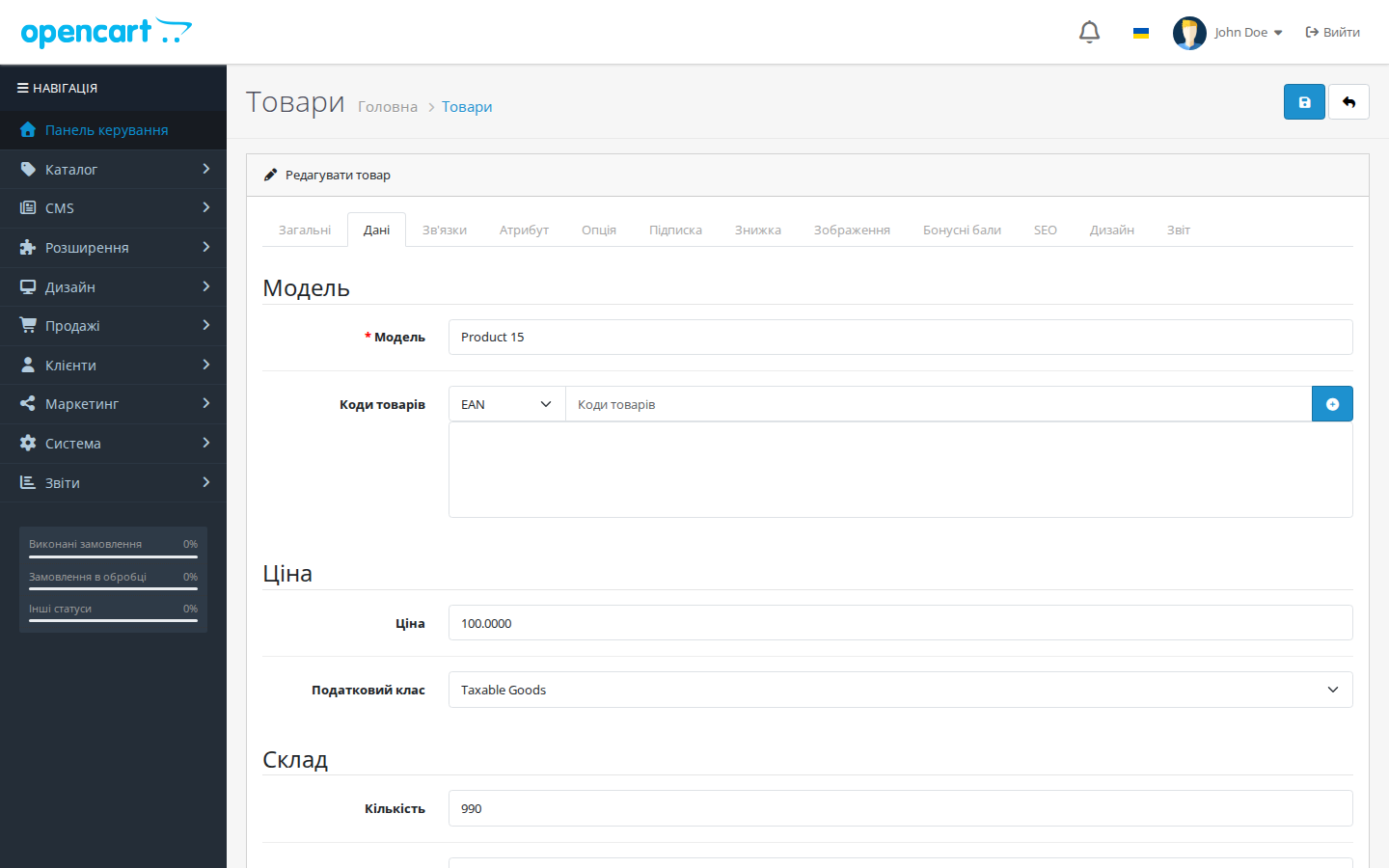
Plan the structure of categories and attributes before the import: reworking thousands of products later costs more than an hour of planning now.
What budgets should be set for the launch and the first months?
A store does not pay off on the first day. Plan for advertising + support for at least 3–6 months ahead. Build a table using this scheme:
- One-time costs: theme, development, modules, content, business registration.
- Recurring monthly costs: hosting, domain, SSL, subscriptions, developer support.
- Advertising: budget for testing (Google, Meta) and for SEO work.
- Working capital: purchasing goods, returns, cash-on-delivery refusals.
- Reserve: roughly 10–20% of the total for unforeseen expenses.
Advertising is a separate question. How much you can pay for a customer depends on margin and repeat purchases; this is covered in materials on CAC and LTV and on the unit economics of an order. Without these calculations it is easy to operate at a loss even with a good site. For Google and Meta feeds see the overview of product feeds.
How do you avoid going over budget and keep costs under control?
The main rule: launch with a minimally viable store and add features based on data, not wishes. Typical causes of overspending:
- ordering "everything at once" — chat, loyalty program, mobile app before the first sale;
- buying several modules that duplicate each other;
- no technical specification and no agreed scope of work;
- ignoring backups and security — recovering after a failure costs more than prevention;
- advertising without tracking orders and margin.
As turnover grows, it is useful to have profit accounting by order. For this there is, among others, Profit — management accounting, and even a simple spreadsheet of revenue minus cost of goods, shipping, commissions and advertising will show whether the store is earning. Terms that come up here are in the e-commerce glossary, and all materials of the section are collected on the store cost and economics page.
Summary
- OpenCart is free, but a store costs money: theme, development, modules, content, legal side, goods and advertising.
- Separate one-time and monthly costs and calculate them together with a reserve for 3–6 months.
- The cost of design, integrations and filling the catalog varies the most — here you need a clear specification and estimates by hours.
- Set aside a reserve and do not buy features you do not need at launch.
- Next: calculate the unit economics of an order and the break-even point to know how much you can spend on advertising.