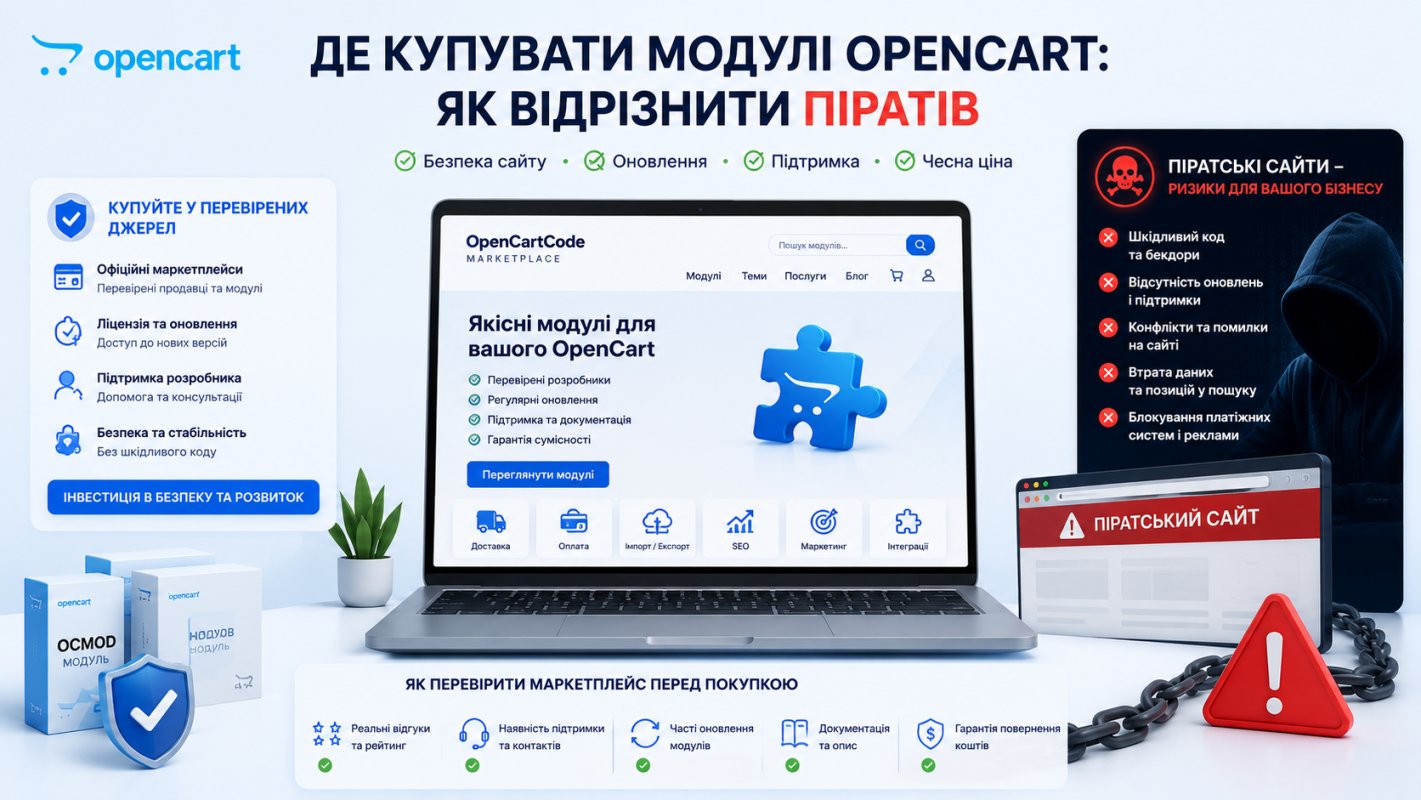
A store operates for months without complaints, and then an order notification email lands in a client's spam folder, casino links appear in the footer, and the hosting provider blocks the account for mass mailing. The owner searches through files looking for a virus and after an hour stumbles upon a module that was downloaded for free from a piracy resource a year ago, which looked like an ordinary website.
What is warez and why it's distributed for free
Warez (from wares) — these are paid modules and templates with cracked protection, distributed without the author's knowledge. Ask yourself a simple question: why would someone spend time cracking ionCube, maintaining a website with hundreds of extensions and servers for distribution, just to give it all away for free? Nobody does this out of altruism. Monetization is built into the files themselves.
The classic scheme looks like this. Something like this is added to the module code:
// catalog/controller/common/footer.php
eval(base64_decode('ZWNobyAnPGEgaHJlZj0i...'));
On the surface, the module works fine. But under the hood sit hidden links for SEO manipulation of other sites, data collection, a backdoor for uploading files, or a script for sending spam through your email. The eval() function allows arbitrary code execution, which is exactly why the official PHP documentation advises against using it. Pirates love it for this very reason: a line in base64 can't be found by searching files for the word "casino".
How this ends in practice
The consequences are not theoretical; I've seen each point below in real stores.
Third-party code and links. Invisible links to other resources appear in the footer or template. Often they're only visible in Google's cached copy because they're hidden with styles from the visitor. Google sees everything though: rankings drop, and you spend months not understanding why.
Spam through your email. A malicious script sends emails through the store's mail server. Symptom: the mail queue on the server is clogged with thousands of emails, the IP gets added to blacklists, and even legitimate order notification emails stop reaching clients. Getting an IP removed from Spamhaus, by the way, is a separate quest that takes several days.
No support whatsostrong>With questions about the cracked module, you can't contact the author: a license check will show that there was no purchase, and you'll simply be blocked. There won't be updates either, so with each new version of OpenCart or PHP, the module becomes a time bomb. Of course, if you pay the full price for the module, support will appear.
Easier hacking. A site with a backdoor is hacked effortlessly, and the hack can go unnoticed for months. The attacker isn't interested in taking the store down: they quietly collect data or do other malicious things.
How to recognize a piracy website
A trained eye needs just two minutes. Main signs:
- Google the website name. Information about well-known piracy resources often appears on the first page of search results.
- The "About us" section. Pirates have generic phrases there about "a team of experienced developers" without portfolio, names, or specifics.
- Extension authors. Hundreds of modules from different developers, but the author is the same everywhere or not listed at all. This doesn't happen on legitimate platforms.
- Demo sites. Either they don't exist, or links lead to real demos from the original authors, from which the module was stolen.
- "VIP accounts" and subscriptions. Access to all extensions from different authors for a single fee is fundamentally impossible on a legitimate platform: authors never agreed to this.
- Legal information. Pirates never provide real details. Contacts only have email and Telegram.
There are also completely obvious markers: words like "nulled", "bulk buy", "leak", "no ioncube" in sections, requirement to like for download, password-protected archives with a paid password, links to file sharing services instead of their own server. See even one, close the tab.
10-second check: warez.rip
Signs are signs, but there's a simpler way. Since May 2018, the OpenCart community has had a non-commercial service warez.rip: enter the address of a suspicious marketplace and immediately get a verdict. The project is run by a community member known by the nickname RGB, and the database is populated by developers whose modules are stolen.
The database now has over 220 piracy sites and is regularly updated. The decision to add a site is made based on a combination of signs, even domain history is taken into account: if a site changes its theme after being added to the database, it won't be removed from the database.
Follow this algorithm: found a module on an unfamiliar website, first run it through warez.rip, and only then everything else. This is the fastest filter available.
Where to buy safely
There are actually few verified platforms, and their list is well known. These are the official OpenCart marketplace, a few established local platforms (their list is also on warez.rip in the "Legal sites" section), and developers' personal websites. Our opencartcode.com is on this list as a marketplace by the authors of the extensions themselves.
And one more argument that somehow is rarely mentioned. The module price includes not just the code, but also support and updates for new versions of OpenCart and PHP. A cracked module is deprived of both, so it's "free" only until the first platform update or the first hack. Calculate how much a day of store downtime costs plus a specialist's work to clean up, and the savings on a 20–30 dollar module looks quite different.
Checklist before buying modules
- Run the website address through warez.rip.
- Check the legal information and contacts: if there's only Telegram there, that's a bad sign.
- If it's a personal website, write to the author directly and confirm authenticity.