Just yesterday, creating an OpenCart module required knowledge of PHP, understanding the system architecture, working with databases, OCMOD, Events and other scary words. Today, it's enough to write in a chat: "Make me an OpenCart module so it works beautifully" (don't make it ugly), and you're already a developer. And if you learn how to formulate prompts correctly, you can open your own development studio.
AI developers are taking over the market. Or are they?
Let's figure out what vibe coding is, why it became so popular, and whether you should trust your online store to people who had no solution yesterday but are selling modules in batches today.
Vibe coding: when anyone can program
The term vibe coding became popular in 2025. Its essence is simple: a person describes the desired result in natural language, and artificial intelligence generates the code. Instead of writing functions yourself, you can explain to AI what needs to be done, get a ready-made solution, check the result, and ask for errors to be fixed.
And it really works.
Moreover, I believe that AI opens huge opportunities for small businesses. What previously required significant expenses or finding a developer can now be implemented independently. For example, create a small script for processing price lists, automate work with Excel, write a parser, or make your own tool for sales analysis. And for this, you don't necessarily need a programmer's degree.
But there's a catch. Generating code and creating a quality software product are not the same thing.
Why everyone fell in love with vibe coding
Let's start with the good, because there's actually quite a lot of it.
First and foremost, it's speed. AI can write in minutes what a developer would spend hours on. Especially when it comes to typical operations, simple scripts, or repetitive tasks.
The second advantage is conditional cheapness. The cost of an AI service subscription can be significantly lower than paying for a programmer's work. However, this is only true if we don't account for the time spent on testing, fixing bugs, and possible consequences of failed implementation.

Another plus is independence. You don't need to find a developer, explain the task to them, wait for your turn, and agree on every detail. You can experiment on your own and learn along the way: AI is capable of explaining unfamiliar code, helping you understand system architecture, and suggesting why a particular solution works the way it does.
And, of course, there's one more undeniable advantage - the feeling that you're a guru of IT. Yesterday you didn't know where the product controller was in OpenCart, and today you're confidently talking about architecture optimization and business process scaling.
As long as OpenCart itself doesn't find out.
When speed starts working against quality
In my opinion, the biggest problem with vibe coding is not the quality of the generated code as such. AI can write quite decent code, and a person can write something that even AI will refuse to explain later.
The problem arises when a person who has received a ready-made solution doesn't have enough expertise to evaluate its quality. They can't confidently determine whether the business logic is implemented correctly, whether the code is secure, whether it conflicts with other modules, or whether it creates problems that will appear in a few months.
Now there are more and more solutions created with the help of AI. Some of them are free, some are sold for quite decent money. And I see how some newly-minted "developers" who, before AI appeared, didn't show any particular activity in creating software products, suddenly experience their prime time.
Modules are being churned out in batches. Today a delivery module, tomorrow a discount module, the day after tomorrow an integration with a marketplace. The productivity is such that you can only envy.
But judging by the nature of some support requests, the question arises: is enough time spent testing these solutions?
After all, the speed of code generation does not mean that the time needed to verify its operation is proportionally reduced. Sometimes the opposite is true: AI can generate hundreds of lines of code in a matter of minutes, which then have to be analyzed, tested, and fixed for hours.
Or you could skip testing altogether. Release the module for sale, and let users figure it out themselves. Found a bug? Great, thanks for the feedback!
You didn't just buy a module. You became a participant in a testing program. A free tester of a paid software product.
One story about why testing is more important than speed
I'll tell you a story from my own experience.
Long ago, I worked in the IT department of a large retailer. There were many projects, even more tasks, and of course, everything needed to be done yesterday.
Once I was working on a task that was extremely urgent. My manager reviewed my work and told me to deploy it to production. I wanted to test everything first, but according to her, there was no time for that. So we deployed it and forgot about it.
Until it was time to analyze the data.
And it turned out that the data was being recorded with completely different logic than it should have been. Consequently, the management reports, to put it mildly, did not match reality.
Guess who was blamed and who had to deal with the consequences? Of course, me. Because what manager would take responsibility for a verbal order?

Fixing the data cost me approximately a week of sleepless nights. I couldn't load the system during the day, so I had to work at night. But I learned a lesson that stayed with me forever: from then on, I simply wouldn't give the go-ahead that a task was complete until I had tested it myself and made sure everything was working correctly.
And there's an important point here. Not just working, but working exactly as it should work. These are fundamentally different things, and this distinction is often not understood by people who start developing with AI without proper technical training.
OpenCart works. But there's a catch
Let's get back to our modules.
Suppose AI created a module for automatic discount application. You installed it, checked one product, saw the correct price, and happily clicked "OK". Everything works.
But now imagine that the product is already participating in a promotion. Or the customer belongs to a different buyer group. Or the product has options with additional pricing. What if a coupon is applied? What if the buyer changes the quantity of items in the cart? What if two conditions that change the price calculation logic are triggered simultaneously?
These are not fantastical scenarios, but ordinary situations that online stores face. And checking only that the module was installed, turned on, and performed one operation is not enough. Especially if it interferes with order price calculation, inventory management, work with customer data, or information exchange with external systems.
A mistake in button formatting is unpleasant. But a mistake in order price calculation is money. And often not the developer's money.
Another story. All coincidences are accidental
I had another interesting experience.
Once after a developer's work, normal product management in my OpenCart admin was disrupted. And we didn't notice it right away. The site worked, orders came in, everything looked quite decent on the outside. But a few months later, when we needed to change products, it turned out that something was working incorrectly.
I asked the developer if these problems could have resulted from his work. The answer was confident: no, they couldn't.
Then I asked exactly where the changes were made. And it turned out that the developer didn't remember. I asked him to "recall," but I never got an answer.
Interesting, right? A person is confident that their work couldn't have caused the problem, but can't say what exactly they changed.
In the end, I found the cause myself. Yes, the problem did result from those changes. And the comments in the code suggested that AI was used to solve the problem.
Of course, the comments themselves don't prove that the code was written by artificial intelligence. But in this story, what matters more is something else: the developer couldn't reproduce his own changes and explain their impact on the system. And that's a problem regardless of who wrote the code.
I could say that I should have tested everything immediately after installation. Yes, I should have. But there's a catch: I didn't know what exactly needed to be tested. Because I'm not an expert in that particular area where the work was being done.
The task was supposed to solve one problem, but the problem appeared where no one expected it. The problem only manifested itself several months later, when there was a need to perform an operation that I don't do on a daily basis.
And here we approach the peculiarities of OpenCart.
Why this is especially relevant for OpenCart
OpenCart is a fairly flexible system. That's precisely why we love it. You can install extensions, change the store's logic, add custom functions, and integrate external services. But flexibility has a downside.
In OpenCart, modules, the Events system, the OCMOD modification mechanism, and other tools are used to extend functionality.
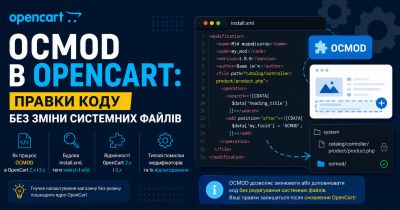
OCMOD, for example, allows you to change system behavior without directly editing the original core files. However, multiple modifications can affect the same file or section of code.
And if a developer doesn't understand how these mechanisms interact, he may solve one task and accidentally break another module.
For example, change the product saving logic without considering that another extension uses the same process. Or interfere with controller operation without checking all scenarios of its use. Or change an SQL query so that it starts returning incorrect data under certain conditions.
The worst part is that such errors are not always accompanied by a full-screen message. Sometimes the store continues to work, just incorrectly. And the owner finds out about it when the problem has already affected orders, inventory, prices, or other business processes.
And does the developer himself know what AI wrote for him?
That's where I have the most questions for the new wave of AI developers.
Does the person understand the architecture of the solution they're selling? Can they explain which files the module changes and which database tables it accesses? Do they know how the installation and removal mechanism works? Did they check compatibility with other popular modules?
And most importantly: is she capable of understanding that AI makes mistakes?
Because if the only way to verify the correctness of one AI's answer is to ask another AI, then we have quite an interesting quality control system.
Especially when the second AI confidently confirms that the first did everything correctly, and the third recommends clearing the cache.
And all three are right. At least in their own answers.
Security: something you don't want to think about at all
There's another problem that cannot be ignored - security.
An OpenCart module can work with customer personal data, order information, accounts, API keys, and other sensitive data. Errors in access control verification, input parameter processing, or database operations can create vulnerabilities.
And this is not just my concern. OWASP, an international organization dealing with software security, separately addresses the risks of using AI for code generation. Among them are unsafe dependencies, unforeseen file changes, insufficient verification of results, and excessive trust in generated code.
OWASP also emphasizes that AI development should not bypass standard security review procedures, testing, and change control.
And if professional development teams pay special attention to this, why should we assume that a person without appropriate expertise can simply generate a module, install it in a store, and hope for the best?
Especially if this module gains access to the administrative part of the site or the database.
AI does not cancel the profession of developer
And here I want to make an important clarification. I'm not against AI in development. On the contrary, I believe it's an extremely useful tool that is already changing approaches to software creation.
An experienced developer with the help of AI can work faster, automate routine operations, analyze code, and spend more time on complex tasks. And a person without technical education can get the opportunity to realize ideas that previously remained only ideas.
But there is a difference between using AI as a tool and completely handing over responsibility for the result to it.
AI can write code. But it does not become a developer who is responsible to your business for the consequences of its work.
And if a person sells a module, they are not just selling an archive with files. They are selling a software product that must perform the stated functions, not disrupt the operation of the store, and be suitable for further maintenance.
The fact that the code was created with the help of AI does not relieve the seller of responsibility for its quality. Just as using a calculator does not relieve an accountant of responsibility for incorrect calculations.
How not to become a free tester
Now a bit of practice.
If you are buying an OpenCart module, especially from a new developer, I would pay attention not only to the list of features and beautiful screenshots. It is important to understand what exactly you are installing in your store.
Before installation, it's worth clarifying which versions of OpenCart and PHP the module has been tested with, which files, database tables, and system mechanisms it changes, whether there is documentation and an update history. It is equally important to understand what happens after disabling or removing the module and whether you can restore the previous state of the store if something goes wrong. Does the module contact the developer's server, and what will happen if the server is unavailable?

And, of course, you should not install new modules directly on a working store if there is an opportunity to test them on a test copy first. This especially applies to extensions that work with orders, payments, inventory, prices, and customer data.
But even a test copy does not guarantee that you will find absolutely all problems. So I would also pay attention to how well the developer documents their own work and whether they are able to explain what exactly their module changes. And definitely would not choose modules where even support responses are provided by an AI bot.
Because the response "this could not have happened because of my work" carries much more weight when a person remembers what exactly they did.
So should you avoid all AI-written modules?
No. Otherwise, you'll soon have to stop installing any modules at all, because determining who and how much used AI during development will become increasingly difficult. And the fact of using AI itself says nothing about the final quality of the product.
A bad developer can write bad code on their own. A good developer can create a quality product with the help of AI. And a person without sufficient expertise can generate a completely functional module, but turn out to be unprepared for the first atypical error. And for modules that work with third-party APIs, it is important to understand how quickly the author can make changes if the API changes.
Therefore, I would avoid not AI modules, but developers who do not understand their own code, do not test their solutions, and cannot explain what exactly they changed in your store. And it doesn't matter how many years they have been developing and what tools they use.
Because ultimately, the responsibility for your store's operation will remain with you. Not with ChatGPT, not with Claude, and not even with the developer who has already forgotten which file they made changes to.
So test, verify, make backups, and do not allow anyone to turn your store into a testing ground for experiments.
So that one fine day you don't find out that the new AI chatbot in your store is recommending customers to switch to competitors because it's cheaper there.
And, most offensively, it might even be right.